

 English
 русский
 Español
 عربى
عربى40ft Custom Air Compressor Container
Specialized Shipping Container | 40ft Custom Air Compressor ContainerOverall Dimensions: 12192 × 2438 × 2896mmLarge...
Content
Choosing the wrong reefer container is one of the most expensive mistakes a cold chain operator can make. Undersized units force partial loads and extra trips, while an oversized or poorly insulated container wastes energy keeping empty space cold. At Yangzhou Yichengke Integrated Technology Co., Ltd. (EHT), we work with fruit exporters, seafood processors, and pharmaceutical distributors every week who come to us after a mismatched container cost them spoiled cargo or a failed compliance inspection. Getting the specification right the first time is almost always cheaper than replacing a container mid-contract.
Size selection starts with route length and cargo density, not just total tonnage. Short domestic runs with frequent reloading favor smaller, more maneuverable units, while long international voyages benefit from larger capacity per trip to reduce the number of connections and handling touches. We produce our reefer container range across multiple footprints specifically so customers do not have to force one size to fit every route in their network.
Not every perishable cargo needs the same thermal profile. Fresh produce generally needs stable chilled temperatures with strong airflow circulation, while proteins and seafood destined for long storage often need rapid pull-down to sub-zero temperatures before the transport phase even begins. The table below outlines how our core reefer models are matched to different cargo profiles.
| Container Type | Best Suited Cargo | Key Advantage |
| 20 Feet Food Reefer Container | Fresh produce, dairy, beverages | Compact footprint, stable chilled range |
| 20 Feet Quick-Freeze Reefer Container | Seafood, meat requiring rapid freezing | Faster pull-down to sub-zero temperatures |
| 40H Food Reefer Container | Bulk export produce and packaged food | High-cube capacity for long international routes |
| 40 Feet Railway Reefer Container | Rail-based inland cold chain distribution | Reinforced structure for continuous rail vibration |
| 10 Feet Offshore Reefer Container | Platform resupply, marine catering | Modular design built for offshore conditions |
The refrigeration unit gets most of the attention, but insulation quality is what determines how hard that unit has to work. Thicker, high-density insulation panels reduce heat ingress through the walls, roof, and floor, which lowers both energy consumption and the temperature recovery time every time the doors open for loading. Combined with an efficient compressor and airflow design, well-insulated units maintain tighter temperature tolerances with less power draw, which matters most on long voyages where generator fuel or shore power access is limited.
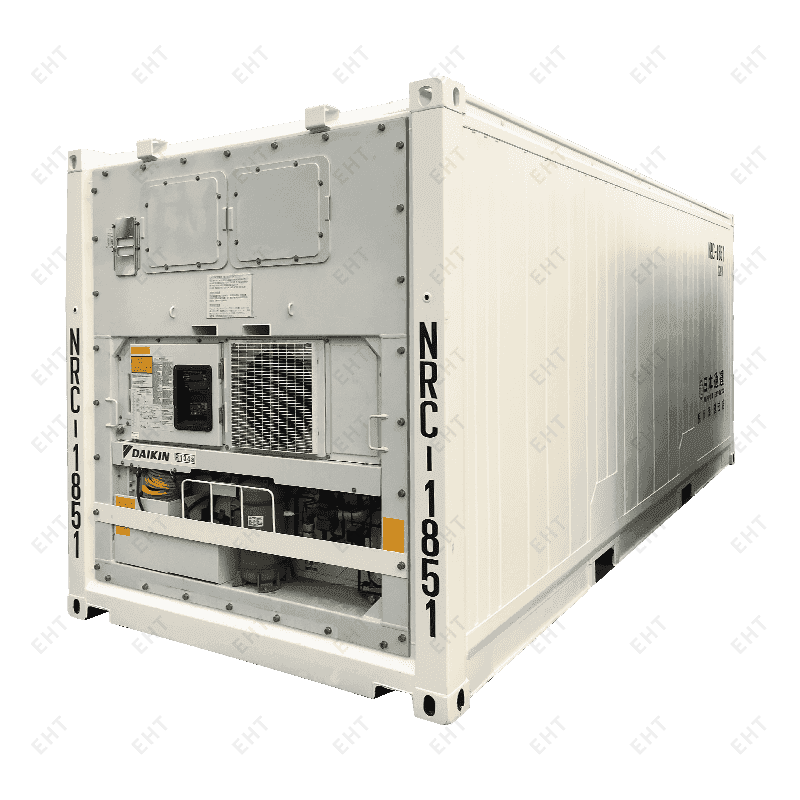
Standard sizes cover most needs, but many operators eventually run into a route, cargo type, or regulatory requirement that a catalog unit was not built for. As a manufacturer rather than a reseller, EHT designs and builds our reefer container range in-house, which means we can adjust insulation thickness, internal fittings, or structural reinforcement for a specific project instead of asking customers to compromise. If your cold chain operation is evaluating new equipment, working directly with the factory on specification is usually the fastest way to land on a unit that fits your route and cargo instead of the other way around.

What to stay up to date?
Contact us via the email address below.
No. 178, Wuzhou East Road, Economic Development Zone, Yangzhou, Jiangsu.
Copyright 2024 Yangzhou Yichengke Integrated Technology Co., Ltd. All Rights Reserved.

